1.02.2013

A new dimension of the Internet and more - a review of the year 2012

In which direction is the market heading? What technologies are most likely to succeed? We present five, most important technological trends that have been discussed in our Newsletters and, according to us, will be growing in the next years.

1. Internet of Things - the nervous system of our planet

Internet of Things (IoT) is a vision in which everyday objects communicate with each other and the users via the Internet, infrared, and radio waves. Appropriately programmed devices and appliances will become "intelligent", eliminating many of the chores consuming our time - the fridge will organize shopping of food products, the air conditioning system will adjust to environmental conditions based on local weather data etc. The number of possible applications is infinite - the technology implemented "in the background" can penetrate all aspects of our material world. The IoT scope will be limited only by the imagination of the manufacturers.
According to Cisco, IoT was born in 2009, when the number of devices connected to the Internet became higher than the population of people living on Earth. However, the year 2012 initiated a new way of thinking about this potential, both in the case of industry and consumers.

2. Cloud computing
Cloud computing is a model of providing IT solutions and services via the Internet, where client computers have continuous access to resources and computing power of servers around the world. This functionality is defined as a service accessible via web software and the necessary infrastructure, giving the users "added value". This means no need for the users to purchase and manage the extensive versions of the software that should be normally installed on their workstations. The main advantages are cost savings associated with moving the computing power from client computers to the servers, the ease of access to services ("everywhere and on everything"), and improved safety.
3. Touch, gesture and voice control
Touch screen market is growing at a very fast pace, much faster than the market of standard screens. A large part of it make smartphones and tablets, the increasing popularity of touch control interface has been even noticed by Microsoft in its new operating system - Windows 8. The system fully supports modern laptops and tablets equipped with such screens.

Voice control also becomes a standard functionality of many electronic devices. The voice recognition software is constantly developed to improve "understanding". An example is the Siri software from Apple. Such programs are used not only in smartphones. At this year's CES, speech recognition functions were demonstrated in TVs, laptops and additional remote controls.

4. High-speed streaming

LTE/4G networks offer a revolutionary speed of mobile Internet (download rates up to 150 Mbps). This technology allows users ultra-fast access to websites with multimedia and games on the Internet. LTE and popular streaming applications enable them to watch video in a good quality on the go. There are available first smartphones equipped with LTE modems.

5. TV market is moving to the Internet
Streaming of television channels via the Internet instead of using dedicated broadcasting networks ensures openness and versatility - the programming can be received on all devices that allow access the Internet (computers, smartphones, televisions equipped with network cards). The year 2012 was quite revolutionary in this respect - almost every new television had network interface and offered access to video on demand and social networking sites. The introduction of the Internet to TVs is also popularizing such services like HbbTV (Hybrid TV) and "Second Screen" supplementing broadcast content with multimedia applications available on other devices (tablets, smartphones, laptops etc).


Will we observe rapid development of the trends in 2013? Or new ones will emerge, with equally great potential, which may affect the shape of the technology and media industries and even change our daily lives? In today's world we may be sure of that.

12.28.2012

How to solve compatibility problems between a TP-LINK 3G router and some 3G modems?

For a wide compatibility, TP-LINK company tests its routers with all popular 3G modems and continually updates the firmware and the list of compatible modems. Despite these efforts, there may be some items that present compatibility problems.

To solve such a problem, the user can perform the following actions:

  • Way 1. Due to the mentioned constant firmware updating, the user should first try to find the 3G modem on the current list of compatible devices. If the modem is on the list but the status window of the router shows information about an unrecognized device (Unknown Modem), the user should update the router firmware. The latest firmware is available at tp-link.com. After downloading, it can be installed by selecting System tools->Firmware Upgrade.
  • Way 2. If a 3G modem has not yet been included into the latest firmware update, there is a chance that the suitable software can be found in 3G Modem Bin File Center. The suitable binary file should be downloaded onto a computer's hard drive and then loaded to the 3G router.
     
3G Wireless Router: TP-LINK TL-MR3420 (802.11n, UMTS/HSPA)
3G Wireless Router: TP-LINK TL-MR3220 (802.11n, 150Mb/s, UMTS/HSPA)
3G UMTS/HSPA TP-LINK router
TL-MR3420 802.11n 300Mb/s N2957
3G UMTS/HSPA TP-LINK router
TL-MR3220 802.11n N2958


3G Wireless Router: TP-LINK TL-MR3020 (802.11n, 150Mbps, UMTS/HSPA)
Mobile 3G Router: TP-LINK TL-MR3040
3G UMTS/HSPA TP-LINK router
TL-MR3020 802.11n N2959
Mobile 3G TP-LINK router
TP-LINK TL-MR3040 N2960

12.27.2012

Multimode or single-mode fiber?

In recent years, due to the wide use of fiber optic technology for data transmission, the market has experienced large declines in prices of optical cables and devices, so they have become accessible to many users. They often consider which kind of the cables and equipment will be optimal for their applications, multimode or single-mode?

The best solution is to compare the total prices of the materials and devices for a particular application. Let's think of a 100 Mbps fiber-optic link. This task can be carried out with the use of a pair of media converters. In the case of using multimode fibers, it can be L10021, with range up to 2 km (requires two fibers). Similar pair of media converters for a link with two single-mode fibers is L11041.


Chart showing comparison of costs of fiber optic links based on multimode and single-mode fibers,
taking into account the prices of the mentioned active devices


The pair of media converters for multimode cables costs ca. 20% less than that of the single-mode equivalent. However, due to lower prices of single-mode cables, the difference in total costs is compensated even in the case of comparatively short links (50 meters). The comparison is based on the prices of universal cables with 4 fibers, L7644 and L7354.

The conclusion is that installations based on multimode fibers are cheaper only in the case of very short links, but generally the difference is no so large. Due to larger potential of single-mode fibers, the choice of single-mode solutions is more prospective. Multimode fibers should only be used for very short links, in server rooms etc. Single-mode fibers are basically the only reasonable solution for data transmission over greater distances.

12.21.2012

"Gigabit Wi-Fi" for everyone now

D-Link Corporation, one of the world's largest network equipment manufacturers, has introduced Wireless AC1200 Dual Band USB Adapter supporting 802.11ac draft standard. Although first 802.11ac devices were offered on the market six months ago and the first company in the world that presented a prototype of 802.11ac router was Buffalo at January's Consumer Electronics Show in Las Vegas, the product of D-Link really opens up the market for this kind of equipment. The adapter enables the user to transfer data wirelessly at speeds about 1 Gbps, which is ideal e.g. for flawless HD video streaming.

D-LINK AC 1200 adapter supporting 802.11ac draft.
Although at present the price is rather high (about $90, several times more than the cost of popular 802.11n devices), everyone can expect that D-Link will be followed by other manufactures, including TP-Link,
and the cost of such solutions in 2013 will not be a barrier for most potential users. [dlink.com]


The "Gigabit Wi-Fi" is based both on solutions used in the IEEE 802.11n standard and new ones, which together allow for the unprecedented throughput. The devices compliant with the future 802.11ac standard (the approval of its final specification is expected in late 2013, the current devices are based on draft 4.0) will operate in the 5 GHz band, at data transfer rates at the level of 1 Gbps (multi-station WLAN throughput). However, there are plans for 2015 to launch first chipsets enabling wireless transmission transfer rates up to 7 Mbps, previously unimaginable for this medium.

Such data rates will be possible with the use of high-density 256 QAM modulation, extra-wide 160 MHz channels, and up to 8 MIMO spatial streams. Additionally, Multi-user MIMO (MU-MIMO) technology will allow multiple clients (each with one or more antennas) to transmit or receive independent data streams simultaneously. In the case of using several antennas, the Space Division Multiple Access (SDMA) well known from MIMO applications in n standard can provide higher throughput as well. The 802.11ac chipsets supporting MU-MIMO are expected in 2014.


Comparison of data transfer rates provided by 802.11ac and 802.11n solutions
[dailywireless.com]
 
 
Other leading manufacturers, such as Netgear, Cisco/ Linksys, also expand their offerings with 802.11ac devices. It is expected that in 2013 - along with the official approval of the standard - the market will also offer laptops with wireless cards in this this technology. The response of smartphone industry can be even quicker - in late 2013 probably 70% of smartphones will be equipped with the appropriate chipsets. The next two years will show how quickly the 802.11ac standard penetrates the WLAN market. The 802.11n standard, approved in 2009, and winning real popularity in 2012, would have to go to early retirement. So, it seems that wireless standard developers and equipment manufacturers are slightly ahead of the current needs of the users.

12.13.2012

The beginning of a revolution in medical care

Isonas, a British company, announced that in collaboration with Fujitsu and Tolven companies it had developed the world's first wireless medical monitoring system based on cloud computing, compliant with the guidelines of the European Medical Device Directive (MDD).

The system consists of network procedures for recording and analysis of medical data and certified sensor LifeTouch HRV011 continuously measuring five vital parameters and providing them wirelessly in real-time: Heart Rate (HR), Respiration Rate (RR), Blood Pressure (BP), Pulse Oximetry (SpO2), and Temperature (T). Other sensors can be easily added to the network.

The system can be used both for large groups, for example, all residents of a city, and in some hospitals. Currently, practical tests are conducted on a group of hospital patients in the Netherlands, the system will soon be testes in the UK and India.


The LifeTouch HRV011 sensor is one of the elements of the certified wireless medical care system based on cloud computing
source: www.isonas.com
 
 
New developments associated with remote medical care are also visible in the U.S.A. In May, the FCC (Federal Communications Commission, agency that regulates the rules for the use of radio frequencies in communication), approved the technical studies on the assignment of radio spectrum for wireless monitoring of patients. The spectrum for MBAN (Medical Body Area Network) will be allocated between 2.360-2.400 MHz. The final approval of the standard is planned for 2013.

The new technologies have to incorporate two principles: to provide the patient with basic medical supervision at the appropriate level and reduce the costs, compared to conventional systems. Additionally, through online monitoring and analysis of the data doctors can immediately react to potential threats to the patients.

12.11.2012

How to set up video streams of IP cameras?

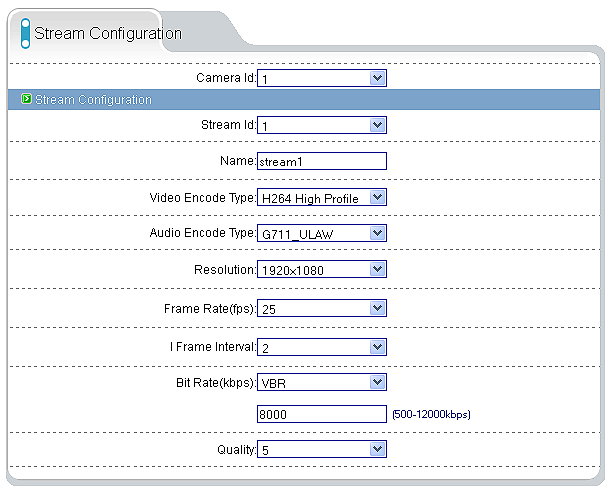
All Sunell IP cameras enable the user to define two independent H.264 video channels. This feature allows for creating high quality stream for video recording and lower quality stream for monitoring over the Internet, e.g. on mobile devices.
Depending on the purpose, the menu of the cameras provides several levels of video compression (Video Encode Type):
  • Base Profile - for low-cost applications that require additional data loss robustness like in mobile environments.
  • Main Profile - used for standard-definition imaging, e.g. on tablets, netbooks etc.
  • High Profile - dedicated for monitoring in local networks and for high-definition video recording. The compression is more effective than in the case of Main Profile (file size ca. 10% smaller for the same quality), but it requires the highest processing power.
Depending on the number of cameras and link/network capacity, the user should select:
  • required image Resolution (1920x1080/1280x720/640x360);
  • Frame Rate (1...25 fps);
  • I Frame Interval (the interval between reference pictures that represent fixed images independent of other picture types). If a camera monitors an area with low traffic, higher values will save the band without noticeable deterioration in image quality;
  • Bit Rate type and value (VBR - variable bit rate which cannot exceed the maximum value defined below by the user, dedicated for monitoring low-traffic areas, or CBR - constant bit rate, also defined by the user, dedicated for monitoring more dynamic envirinments);
  • Quality level, within the 1 (minimum) to 9 (maximum) range.
Stream parameters must be chosen with care and tested in practice - too high settings will result in ​​unnecessary load on the network and the NVR's CPU, too low values will degrade the image quality.

Multiswitch SMATV system in a 5-staircase building

The requirements for the building installations included SMATV system providing each outlet with DVB-T and SAT signals (from a single Hot Bird position).

The building has five staircases with a 40 m spacing. There is an underground garage in the basement below the ground level (first flloor). The basement should be used for the distribution of the signals to all the staircases (the investor did not want separate systems in individual staicases) via a bus composed of five Triset-11 PE E1025 cables.

UHF TV Antenna: DIPOL 94/21-69 Vena
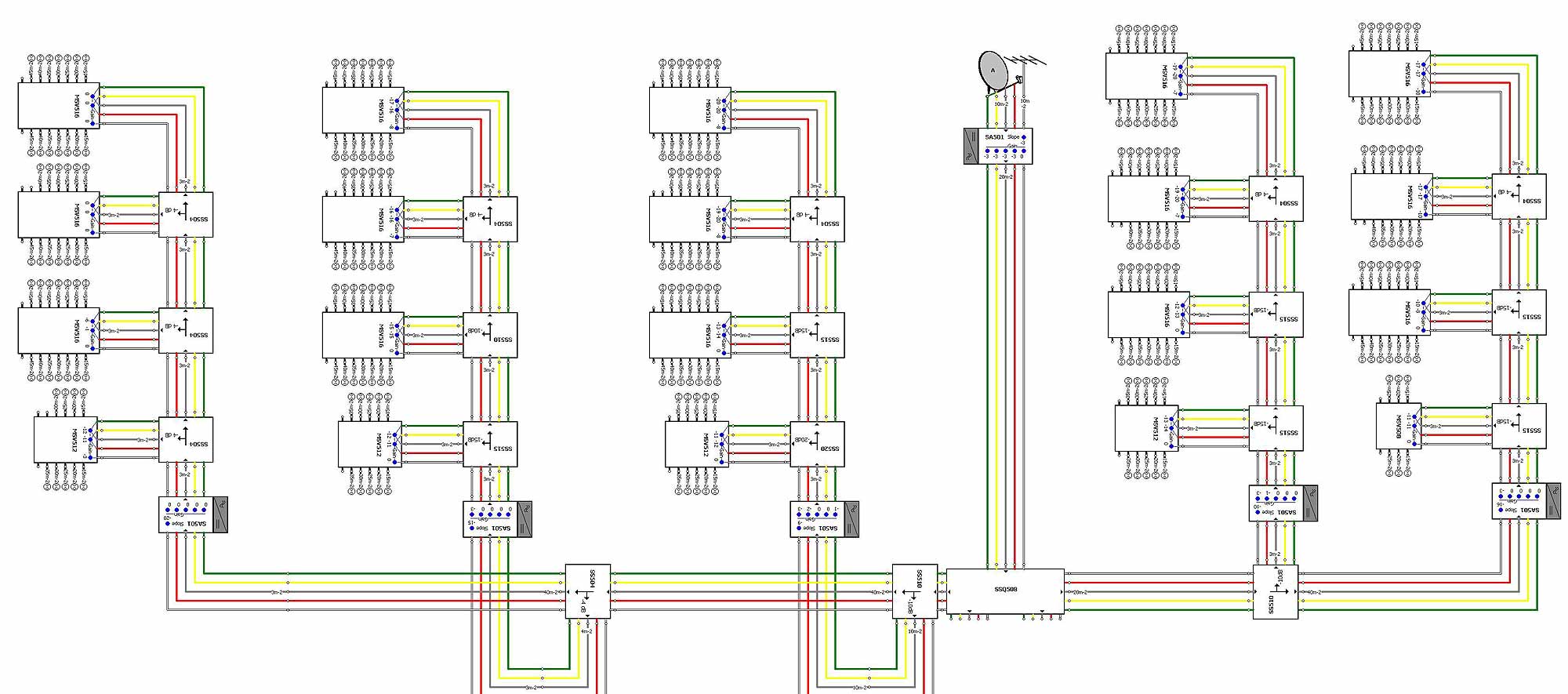
View of the project of the SMATV system designed with the use of free SatNet utility
Instructional video on the use of the software
 
 
Due to a large number of the outlets in the building (ca. 300), the optimum choice was multiswitch system based on a bus architecture and MSV-5xx multiswitches.
 
In this implementation, three stories in each staircase have been equipped with MSV-516 R70716 multiswitch and satellite splitter or tap from Terra SS-5xx series with the loss resulting from the energetic balance. The exception is the last, fourth floor, equipped in each staircase only with the MSV-516 R70716 multiswitch. The total number of outlets in each staircase is about 60.

The system is powered from SA 501 R70501 amplifiers located in each staircase, via H lines.