Showing posts with label IP cameras. Show all posts

12.11.2012

How to set up video streams of IP cameras?

All Sunell IP cameras enable the user to define two independent H.264 video channels. This feature allows for creating high quality stream for video recording and lower quality stream for monitoring over the Internet, e.g. on mobile devices.
Depending on the purpose, the menu of the cameras provides several levels of video compression (Video Encode Type):
  • Base Profile - for low-cost applications that require additional data loss robustness like in mobile environments.
  • Main Profile - used for standard-definition imaging, e.g. on tablets, netbooks etc.
  • High Profile - dedicated for monitoring in local networks and for high-definition video recording. The compression is more effective than in the case of Main Profile (file size ca. 10% smaller for the same quality), but it requires the highest processing power.
Depending on the number of cameras and link/network capacity, the user should select:
  • required image Resolution (1920x1080/1280x720/640x360);
  • Frame Rate (1...25 fps);
  • I Frame Interval (the interval between reference pictures that represent fixed images independent of other picture types). If a camera monitors an area with low traffic, higher values will save the band without noticeable deterioration in image quality;
  • Bit Rate type and value (VBR - variable bit rate which cannot exceed the maximum value defined below by the user, dedicated for monitoring low-traffic areas, or CBR - constant bit rate, also defined by the user, dedicated for monitoring more dynamic envirinments);
  • Quality level, within the 1 (minimum) to 9 (maximum) range.
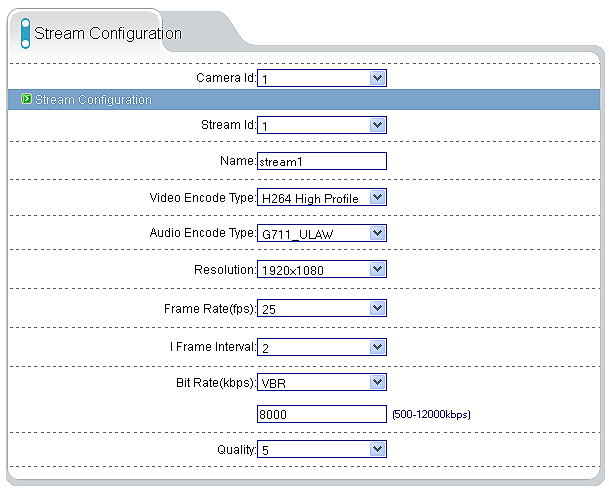
Stream parameters must be chosen with care and tested in practice - too high settings will result in ​​unnecessary load on the network and the NVR's CPU, too low values will degrade the image quality.

11.05.2012

Cloud-based video monitoring is gaining popularity.

Securicorp Components Ltd., a UK-based security services company, has launched a monitoring service based on the concept of cloud computing, where the resources, software, and data storage system are available in the cloud. Although cloud video surveillance is a hot subject in the industry, the service is one of the first market offerings for companies and individuals.
The clients will control and manage their systems online, through account usernames and passwords, the video data will be stored on external servers - "in the cloud". The installation and configuration of the IP cameras on site will be as simple as possible - the users don't need to know technical details. To provide the cloud solution, Securicorp has partnered with telecoms, data centers, Internet service providers, and retail companies.

 
So, the whole system of the individual user exists in the virtual world, with automatic update to the latest version and optimization in the background, and surveillance data stored on external servers located outside the monitored facilities. The existence of the system in the form of a flexible digital platform will allow anyone to select features that are really needed, without paying for unnecessary functions.

 
Securicorp and other suppliers of CCTV solutions use ready-made software solutions that allow for the implementation of CCTV in the cloud. The first solution dedicated for ISPs, telecom operators, and security services companies has been offered by NeoVSP. The OVS™ (Online Video Surveillance) belongs to the Video Surveillance as a Service (VSaaS) solutions that minimize the clients' involvement in the network architecture and equipment, usually aside from the cameras. Similar solutions are offered by Iveda Solutions, OzVision, Connexed, iControl.

The change in thinking of CCTV video surveillance a service rather than the physical system opens the door to long-awaited features, including the most expected one: intelligent image analysis. The amount of gathered data, even in medium-sized systems, is so great that also the most modern video monitoring systems have to be treated more as archives than sources of live information. The application of cloud computing technology provides almost unlimited possibilities. It is only a matter of time when IT specialists create algorithms with artificial intelligence techniques allowing for autonomous early detection of real threats.