1.25.2013

Optical power measurements

Fiber networks require high quality workmanship. During installation and maintenance of the networks, the installer should take into account not only the correct fiber splicing, but also the geometry of the laid cables and individual fibers (bending radii).

Optical Power Meter Optokon PM-800
Visual Fault Locator: FM-FOA-FCH
Optical Power Meter
Optokon PM-800
L5818
Visual Fault Locator
FM-FOA-FCH
L5933
 
 
Any irregularity may increase the attenuation of the path, resulting even in the failure of the link. For the convenience of work, every installer of optical networks should be equipped with a suitable set of diagnostic tools. The basic devices are an optical power meter and a visual fault locator.

OPTOKON PM-800 is an advanced meter designed to measure optical power loss in fiber networks based on multimode and single-mode fibers. The meter is calibrated to measure optical power at six wavelengths (nm): 850, 1300, 1310, 1490, 1550, and 1625. AWD (Auto Wavelength Detection) function allows the meter to detect the length of the transmitted wave and automatically adjust measuring parameters. It is possible to set 0 dB reference level so as to make the measurements of an optical path easier.


Visual fault locators can detect fiber faults which are not visible to the naked eye. Mechanical defects
often occur at the ends of the fibers and are the result of poor handling of the cable during installation.


The visual fault locator L5933 is designed to help diagnose problems with fiber optic cabling. The device is designed to test single-mode and multimode fiber optic cables. The output power is sufficient to check even 3 km long links. The FM-FOA-FCH locator allows for detection of light leaks in optical transmission systems. The visible red light (650 nm) can be observed at breaks, bad splices or connectors, improper bends etc, providing an overview of the problem.

1.24.2013

CES 2013 - packed, but without major innovations

The world's largest consumer electronics trade fair - Consumer Electronics Show (CES) - was held in Las Vegas between January 8 and 11. This year there were over 3,000 exhibitors - an absolute record in the 45-year history of the show. Trends that shape the CES are of great importance for the future of consumer electronics - it was the place of the introduction of video cassette recorder (VCR) in 1970, camcorder and CD player in 1981, DVD in 1996, HDTV in 1998, Xbox in 2001, Blu-ray player in 2004. Among the dominant themes at this year's fair the visitors could notice Ultra HD and OLED televisions. They are especially important from the point of view of big TV manufacturers, providing the basis to renew their offerings. On the other hand, one could get the impression that it was the same old stuff - to tell the truth the increase in the resolution from FullHD to 4K did not seem to be a revolution that could be compared to the transition from SD to HD/ FullHD. At this year's CES it was difficult to find a true innovation capable of changing some areas of our lives. However, there were many interesting gadgets...

One of the more interesting items presented by Panasonic was a 20-inch 4K tablet with a thickness of 1 cm, run by Windows 8. The device is to be mainly used by designers, architects, photographers using remote access to servers (cloud computing). The advantage is primarily the large diagonal of the display - an easy-to-use interface for professional applications.


View of the 20-inch tablet from Panasonic

LG presented a curved flatscreen OLED TVs with 55-, 65- and 84-inch diagonals. These OLED devices were characterized by extremely realistic picture, and the curvature of the screen helped to obtain more natural depth of space. In the future, curved screens will probably enable 3D viewing experience without glasses.


OLED TV from LG - will similar televisions offer 3D without glasses?
 
 
A very similar technology of curved televisions was presented by Samsung. In addition, the Korean giant unveiled the F9500 model, the first TV in the world offering Multi-View function allowing viewers to watch two different TV broadcasts at the same time. This is possible with the use of dedicated 3D glasses synchronizing with the chosen picture, whereas personal headphones provide the appropriate audio channel.
At CES, there were also gadgets of the future such as ... rifle with Linux operating system, performing calculations necessary for shots at long distances. For example, the software chooses the optimum moment for taking the shot, informing the shooter. The solution is very similar to that currently used in modern fighter planes. The gun with built-in wireless interface can connect to iPhone / iPad and provide the live image from the sight, e.g. for training others.

The rifle running Linux operating system - it can calculate
 and select the optimal moment of shot release


Technological innovations were also presented by the automotive industry. Audi showed its version of a self-driving car. The German company, similarly to Google and Lexus, has been working on a fully autonomous vehicle. At the moment, the Audi solution allows the owner of the car to call it with a smartphone from a remote location in the parking lot.

Call this with a smartphone - autonomous Audi car


As usual, there were given BEST OF CES AWARDS. The winners can be sure of making profits - promotion at the fair in Las Vegas is the best marketing. Careful selection of nominations and professionalism of the jury give consumers practical advice which products are worth their money. This year's indication is on Ultra High Definition televisions and OLED technology.

1.16.2013

With light, but without the fiber

British scientists have started work on a new wireless communication system not using ubiquitous radio waves but laser light. The new technology, as usual, has been originally focused on military applications, but it can be quickly implemented in the civilian sector where the demand for broadband solutions is enormous. Until then, however, the scientists have to complete a series of tests. At the moment, they are carrying on research on the transmission of audio signals from drones to a receiving station. As a sample they use the well-known AC/DC song - "Highway to Hell".

Such drones are to use laser communications
 
 
The main problem of unmanned military aircraft (combat or espionage) is the limited range of operation. To increase the range, engineers gradually reduce the weight of the machines, using lighter components and weapons, which translates into a reduction in fuel consumption of their engines and possibility of longer missions.

EADS researchers led by Yoann Thueux are aimed to introduce a new wireless communication system called Dazzle. Comparatively heavy radio equipment is to be replaced by an optoelectronic device reflecting and modulating the laser light emitted from a control station. So, the principle is simple - the laser beam directed at the flying drone is reflected by the machine back to the the station, together with data from sensors and cameras, and the information is received and processed by the station.

The technology is relatively cheap and provides very efficient data transmission, even at data rates up to 1Gbps. What's more - eavesdropping or monitoring of the transmitted data is not possible, which is extremely important for military applications. Currently, the range of the laser link is limited to about 2 km, but it is probably only a temporary inconvenience.

Research on this technology has been ongoing for some time. In 2008, Hani J. Kbashi from the University in Baghdad published a study on theoretical principles, basic calculations and practical solutions for laser equipment for wireless transmission using Intensity Modulation with Direct Detection (IM/ DD). The EADS project is carried out in parallel and employs the same transmission method.

In the near future, wireless optical transmission may revolutionize the market for multimedia services. Extremely broadband characteristics and easy implementation are the factors that can decide on the popularity of this technology. Maybe, in a short time the light will dominate not only in the cable infrastructure but also in wireless systems.

1.11.2013

The differences between universal and distribution optical fiber cables

Novice installers may have problems with choosing which type of the cable will be optimal for a particular application. Let's focus on the single- and multi-mode cables with 8 fibers, which register the highest sales figures:

Universal cable (left) and distribution cable (right)
1. Optical fiber
2. Gel inside the central tube
3. Central tube
4. Aramid yarn
5. LSZH jacket
 
 
Universal Ultimode cables can be used in indoor and outdoor applications. The fibers are contained in central gel-filled tube. The gel in the tube is a kind of protective coating for optical fibers, which absorbs mechanical stresses and protects against environmental factors.

The universal cables are mainly intended for horizontal connections in buildings and outside buildings. Due to the small size and flexibility, the cables are ideal for installation in cable ducts. They are used in modern FTTH and FTTB systems, in server rooms, between buildings. Because of the gel-filled structure, the vertical cable runs of the cables installed in buildings should not be longer (higher) than 30 meters.

Distribution Ultimode cables belong to the "Minibreakout" category intended for applications in buildings. The fibers in tight buffers are contained in one sheath. Individual fibers are comfortably accessible, which makes it easier to install optical connectors, to make splices etc. The aramid yarn is designed to protect fibers from mechanical damage. The jacket (sheath) is made of low smoke zero halogen flame retardant poly-olefin (LSZH). Indoor distribution cables from ULTIMODE IDC series are gel-free fiber optic cables intended for horizontal and vertical connections in buildings.

1.10.2013

Galileo is already tested!

On December 1, 2012, the testing ground station located in the heart of the Ardennes forest in Belgium received the first test signal from the FM3 satellite put into orbit in the process of forming the European navigation system, Galileo. FM3 and FM4 satellites were sent into orbit in October and joined two satellites launched a year earlier. Galileo global navigation satellite system (GNSS) will be an alternative to the American GPS (Global Positioning System) and Russian GLONASS GNSS. It should be more accurate, and above all, independent from military forces.

The first signal was transmitted by the satellite in band E1 (1559-1591 MHz), also used by GPS. Then, the satellite transmitted signals in the other bands that are to be ultimately used by the Galileo system, E5 (1164-1215 MHz) and E6 (1260-1300 MHz). According to the schedule, subsequent satellites will be launched and tested in the beginning of 2013. The system should become functional by the end of 2014, with 14-18 orbiting satellites.

 
Galileo is a joint project of the European Space Agency (ESA) and the European Commission (EC). The satellites will be deployed in three orbital planes at an altitude of 23 222 km and inclination angle of 56ยบ in relation to the equator. The final system is to have 30 orbiting satellites (27 operational and three spare). The completion of the system is planned for 2020. At the moment, there are four satellites, which is the absolute minimum necessary for testing the efficiency of the system. 

The concept of operation of the Galileo system includes two ground operations centers, in Fucino, Italy, and in Oberpfaffenhofen near Munich (Germany), plus the Safety of Life Center in Madrid for applications where guaranteed precision of time and position is of critical importance, working 24/7 and responsible for rescue operations. The headquarters of the EU Satellite Navigation Agency is Prague.

The advantage of the Galileo system will also be the interoperability with GPS and GLONASS, two other global satellite navigation systems, as well as with other, non-navigation systems. The integration with GSM/UMTS/LTE infrastructure could revolutionize the telecommunications market by offering new services. The simultaneous use of Galileo and GPS will significantly increase the availability of satellite navigation signals in highly urbanized areas (coverage up to 95% of the areas compared with the current 50%). Wider bandwidth and higher power of Galileo transmitters in relation to GPS circuitry will allow the use of satellite navigation in buildings and some tunnels.

1.08.2013

The Brave New World?

Already in several US cities, Comcast Corporation provides cable television services combined with the security and control of "smart homes", under the name of Xfinity Home Security. Signals from home sensors (of motion, smoke, glass break, etc.) and images from surveillance cameras arrive, thanks to wireless transmission, to the home control unit and then are sent to the data center in Colorado. The transmission between the sensors and the control unit is based on the ZigBee protocol which, specially designed for such applications, does not interfere with wireless (WiFi) devices.

Depending on the system settings, some of the data is stored on servers in the data center, other part is analyzed by special software, and some of the information or images may also be sent to the smartphone of the home's owner. The video recordings are stored on the service provider servers for 30 days.

The system can be used for remote control of home appliances and the lighting, heating, etc. It can also be programmed in a more sophisticated way, for example, if a child does not come back home by the programmed time (does not insert the key into the lock), the parent will receive a message on his/her phone. So the users can create their own applications, with the help of the supplied software.

According to Mitch Bowling, SVP and GM of New Businesses in Comcast Cable, responsible for the Xfinity Home Security project, the system is safe due to the encryption of data. It is impossible that a hacker could view video channels or open the locks. However, all data stored on the server can be made available to the relevant authorities, with the consent of the court.

The cost of maintaining such a system consists of the following elements:

  • installation fee - $199,
  • sensors - $70 per one item,
  • security cameras - $150 per one item,
  • monthly service fee for video monitoring and recording - $5,
  • monthly service subscription (depending on the number of devices) - $29.,95 to $39.95.
Similar services have been launched by Verizon Wireless and Time Warner. This year, Google is to start another project, based on the already introduced "Android@Home" framework for home automation and open source applications for control of electrical and electronic devices from mobile phones.
An example of such an application is the Homebuddy utility which communicates with a controller, e.g. Vera Z-Wave, via the Internet or Ethernet network to switch on/off power, adjust temperature, control various devices.


"Homebuddy" in action
 
Google wants to go one step further and create Smart Home system based on cloud computing, similarly to Comcast. Devices such as Vera Z-Wave controller would send information to a central server processing it in order to optimize the performance of the building. The user would only configure the system, also through a web browser or Android smartphone, without a need to adjust the parameters.

Google project would perform more sophisticated operations than just switching on/ off home appliances, for example, it could assist the user in shopping by sending on their smartphone a list of products lacking in the refrigerator or after expiration date.

The idea of ​​smart homes has been known since the 70s of last century and is derived from the automation of industrial production, of which some aspects, brought to everyday life, might make it easier and more economical.

Until now, a lack of standards for control of home systems and appliances, problems of external control arising from connectivity issues and the high cost of data processing - caused that the installation expenses were high and the benefits low. Cloud computing technology can change this situation and accelerate the development of smart homes.

1.04.2013

How to build a low-cost IP CCTV system?

An economical IP video surveillance system can be based on megapixel IP cameras from Sunell. Thanks to the ability to save surveillance data on remote FTP servers (such services are offered by hosting companies), there is no need for buying and maintaining an NVR operating on 24/7 basis. The camera can be directly connected by entering login, password, IP address and port number for FTP connection, so the only additional device is a router with Internet access.


2MP IP Dome Camera: Sunell SN-IPV54/12UDR (Aptina 1080p CMOS, ONVIF, OUTDOOR vandal-proof)ADSL Router w. 4-port Switch & 802.11n AP: TP-Link TD-W8960N
The architecture of economical IP CCTV system with video recording on a remote server
 
 
In order to ensure good image quality, each camera needs at least 1 Mbps upload bandwidth. The files saved on the FTP server can be played back on a computer running application software provided with the cameras or using a typical video player. Live monitoring is available by logging in directly to the camera from any Web browser or on a smartphone running InView application. Local wireless transmission to a laptop on site is safe thanks to the N2904 access point using WPA-/WPA2-PSK, WPA-/WPA2-AES or WEP encryption.

The recording of the surveillance data on a remote server is not only economical and convenient, but also safe. In the case of a robbery etc. the recorded data cannot be destroyed or stolen, because it is not physically on site.

1.02.2013

A new dimension of the Internet and more - a review of the year 2012

In which direction is the market heading? What technologies are most likely to succeed? We present five, most important technological trends that have been discussed in our Newsletters and, according to us, will be growing in the next years.

1. Internet of Things - the nervous system of our planet

Internet of Things (IoT) is a vision in which everyday objects communicate with each other and the users via the Internet, infrared, and radio waves. Appropriately programmed devices and appliances will become "intelligent", eliminating many of the chores consuming our time - the fridge will organize shopping of food products, the air conditioning system will adjust to environmental conditions based on local weather data etc. The number of possible applications is infinite - the technology implemented "in the background" can penetrate all aspects of our material world. The IoT scope will be limited only by the imagination of the manufacturers.
According to Cisco, IoT was born in 2009, when the number of devices connected to the Internet became higher than the population of people living on Earth. However, the year 2012 initiated a new way of thinking about this potential, both in the case of industry and consumers.

2. Cloud computing
Cloud computing is a model of providing IT solutions and services via the Internet, where client computers have continuous access to resources and computing power of servers around the world. This functionality is defined as a service accessible via web software and the necessary infrastructure, giving the users "added value". This means no need for the users to purchase and manage the extensive versions of the software that should be normally installed on their workstations. The main advantages are cost savings associated with moving the computing power from client computers to the servers, the ease of access to services ("everywhere and on everything"), and improved safety.
3. Touch, gesture and voice control
Touch screen market is growing at a very fast pace, much faster than the market of standard screens. A large part of it make smartphones and tablets, the increasing popularity of touch control interface has been even noticed by Microsoft in its new operating system - Windows 8. The system fully supports modern laptops and tablets equipped with such screens.

Voice control also becomes a standard functionality of many electronic devices. The voice recognition software is constantly developed to improve "understanding". An example is the Siri software from Apple. Such programs are used not only in smartphones. At this year's CES, speech recognition functions were demonstrated in TVs, laptops and additional remote controls.

4. High-speed streaming

LTE/4G networks offer a revolutionary speed of mobile Internet (download rates up to 150 Mbps). This technology allows users ultra-fast access to websites with multimedia and games on the Internet. LTE and popular streaming applications enable them to watch video in a good quality on the go. There are available first smartphones equipped with LTE modems.

5. TV market is moving to the Internet
Streaming of television channels via the Internet instead of using dedicated broadcasting networks ensures openness and versatility - the programming can be received on all devices that allow access the Internet (computers, smartphones, televisions equipped with network cards). The year 2012 was quite revolutionary in this respect - almost every new television had network interface and offered access to video on demand and social networking sites. The introduction of the Internet to TVs is also popularizing such services like HbbTV (Hybrid TV) and "Second Screen" supplementing broadcast content with multimedia applications available on other devices (tablets, smartphones, laptops etc).


Will we observe rapid development of the trends in 2013? Or new ones will emerge, with equally great potential, which may affect the shape of the technology and media industries and even change our daily lives? In today's world we may be sure of that.

12.28.2012

How to solve compatibility problems between a TP-LINK 3G router and some 3G modems?

For a wide compatibility, TP-LINK company tests its routers with all popular 3G modems and continually updates the firmware and the list of compatible modems. Despite these efforts, there may be some items that present compatibility problems.

To solve such a problem, the user can perform the following actions:

  • Way 1. Due to the mentioned constant firmware updating, the user should first try to find the 3G modem on the current list of compatible devices. If the modem is on the list but the status window of the router shows information about an unrecognized device (Unknown Modem), the user should update the router firmware. The latest firmware is available at tp-link.com. After downloading, it can be installed by selecting System tools->Firmware Upgrade.
  • Way 2. If a 3G modem has not yet been included into the latest firmware update, there is a chance that the suitable software can be found in 3G Modem Bin File Center. The suitable binary file should be downloaded onto a computer's hard drive and then loaded to the 3G router.
     
3G Wireless Router: TP-LINK TL-MR3420 (802.11n, UMTS/HSPA)
3G Wireless Router: TP-LINK TL-MR3220 (802.11n, 150Mb/s, UMTS/HSPA)
3G UMTS/HSPA TP-LINK router
TL-MR3420 802.11n 300Mb/s N2957
3G UMTS/HSPA TP-LINK router
TL-MR3220 802.11n N2958


3G Wireless Router: TP-LINK TL-MR3020 (802.11n, 150Mbps, UMTS/HSPA)
Mobile 3G Router: TP-LINK TL-MR3040
3G UMTS/HSPA TP-LINK router
TL-MR3020 802.11n N2959
Mobile 3G TP-LINK router
TP-LINK TL-MR3040 N2960

12.27.2012

Multimode or single-mode fiber?

In recent years, due to the wide use of fiber optic technology for data transmission, the market has experienced large declines in prices of optical cables and devices, so they have become accessible to many users. They often consider which kind of the cables and equipment will be optimal for their applications, multimode or single-mode?

The best solution is to compare the total prices of the materials and devices for a particular application. Let's think of a 100 Mbps fiber-optic link. This task can be carried out with the use of a pair of media converters. In the case of using multimode fibers, it can be L10021, with range up to 2 km (requires two fibers). Similar pair of media converters for a link with two single-mode fibers is L11041.


Chart showing comparison of costs of fiber optic links based on multimode and single-mode fibers,
taking into account the prices of the mentioned active devices


The pair of media converters for multimode cables costs ca. 20% less than that of the single-mode equivalent. However, due to lower prices of single-mode cables, the difference in total costs is compensated even in the case of comparatively short links (50 meters). The comparison is based on the prices of universal cables with 4 fibers, L7644 and L7354.

The conclusion is that installations based on multimode fibers are cheaper only in the case of very short links, but generally the difference is no so large. Due to larger potential of single-mode fibers, the choice of single-mode solutions is more prospective. Multimode fibers should only be used for very short links, in server rooms etc. Single-mode fibers are basically the only reasonable solution for data transmission over greater distances.

12.21.2012

"Gigabit Wi-Fi" for everyone now

D-Link Corporation, one of the world's largest network equipment manufacturers, has introduced Wireless AC1200 Dual Band USB Adapter supporting 802.11ac draft standard. Although first 802.11ac devices were offered on the market six months ago and the first company in the world that presented a prototype of 802.11ac router was Buffalo at January's Consumer Electronics Show in Las Vegas, the product of D-Link really opens up the market for this kind of equipment. The adapter enables the user to transfer data wirelessly at speeds about 1 Gbps, which is ideal e.g. for flawless HD video streaming.

D-LINK AC 1200 adapter supporting 802.11ac draft.
Although at present the price is rather high (about $90, several times more than the cost of popular 802.11n devices), everyone can expect that D-Link will be followed by other manufactures, including TP-Link,
and the cost of such solutions in 2013 will not be a barrier for most potential users. [dlink.com]


The "Gigabit Wi-Fi" is based both on solutions used in the IEEE 802.11n standard and new ones, which together allow for the unprecedented throughput. The devices compliant with the future 802.11ac standard (the approval of its final specification is expected in late 2013, the current devices are based on draft 4.0) will operate in the 5 GHz band, at data transfer rates at the level of 1 Gbps (multi-station WLAN throughput). However, there are plans for 2015 to launch first chipsets enabling wireless transmission transfer rates up to 7 Mbps, previously unimaginable for this medium.

Such data rates will be possible with the use of high-density 256 QAM modulation, extra-wide 160 MHz channels, and up to 8 MIMO spatial streams. Additionally, Multi-user MIMO (MU-MIMO) technology will allow multiple clients (each with one or more antennas) to transmit or receive independent data streams simultaneously. In the case of using several antennas, the Space Division Multiple Access (SDMA) well known from MIMO applications in n standard can provide higher throughput as well. The 802.11ac chipsets supporting MU-MIMO are expected in 2014.


Comparison of data transfer rates provided by 802.11ac and 802.11n solutions
[dailywireless.com]
 
 
Other leading manufacturers, such as Netgear, Cisco/ Linksys, also expand their offerings with 802.11ac devices. It is expected that in 2013 - along with the official approval of the standard - the market will also offer laptops with wireless cards in this this technology. The response of smartphone industry can be even quicker - in late 2013 probably 70% of smartphones will be equipped with the appropriate chipsets. The next two years will show how quickly the 802.11ac standard penetrates the WLAN market. The 802.11n standard, approved in 2009, and winning real popularity in 2012, would have to go to early retirement. So, it seems that wireless standard developers and equipment manufacturers are slightly ahead of the current needs of the users.

12.13.2012

The beginning of a revolution in medical care

Isonas, a British company, announced that in collaboration with Fujitsu and Tolven companies it had developed the world's first wireless medical monitoring system based on cloud computing, compliant with the guidelines of the European Medical Device Directive (MDD).

The system consists of network procedures for recording and analysis of medical data and certified sensor LifeTouch HRV011 continuously measuring five vital parameters and providing them wirelessly in real-time: Heart Rate (HR), Respiration Rate (RR), Blood Pressure (BP), Pulse Oximetry (SpO2), and Temperature (T). Other sensors can be easily added to the network.

The system can be used both for large groups, for example, all residents of a city, and in some hospitals. Currently, practical tests are conducted on a group of hospital patients in the Netherlands, the system will soon be testes in the UK and India.


The LifeTouch HRV011 sensor is one of the elements of the certified wireless medical care system based on cloud computing
source: www.isonas.com
 
 
New developments associated with remote medical care are also visible in the U.S.A. In May, the FCC (Federal Communications Commission, agency that regulates the rules for the use of radio frequencies in communication), approved the technical studies on the assignment of radio spectrum for wireless monitoring of patients. The spectrum for MBAN (Medical Body Area Network) will be allocated between 2.360-2.400 MHz. The final approval of the standard is planned for 2013.

The new technologies have to incorporate two principles: to provide the patient with basic medical supervision at the appropriate level and reduce the costs, compared to conventional systems. Additionally, through online monitoring and analysis of the data doctors can immediately react to potential threats to the patients.

12.11.2012

How to set up video streams of IP cameras?

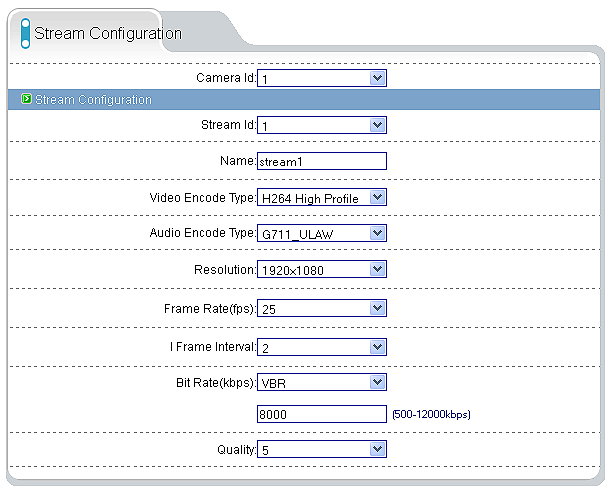
All Sunell IP cameras enable the user to define two independent H.264 video channels. This feature allows for creating high quality stream for video recording and lower quality stream for monitoring over the Internet, e.g. on mobile devices.
Depending on the purpose, the menu of the cameras provides several levels of video compression (Video Encode Type):
  • Base Profile - for low-cost applications that require additional data loss robustness like in mobile environments.
  • Main Profile - used for standard-definition imaging, e.g. on tablets, netbooks etc.
  • High Profile - dedicated for monitoring in local networks and for high-definition video recording. The compression is more effective than in the case of Main Profile (file size ca. 10% smaller for the same quality), but it requires the highest processing power.
Depending on the number of cameras and link/network capacity, the user should select:
  • required image Resolution (1920x1080/1280x720/640x360);
  • Frame Rate (1...25 fps);
  • I Frame Interval (the interval between reference pictures that represent fixed images independent of other picture types). If a camera monitors an area with low traffic, higher values will save the band without noticeable deterioration in image quality;
  • Bit Rate type and value (VBR - variable bit rate which cannot exceed the maximum value defined below by the user, dedicated for monitoring low-traffic areas, or CBR - constant bit rate, also defined by the user, dedicated for monitoring more dynamic envirinments);
  • Quality level, within the 1 (minimum) to 9 (maximum) range.
Stream parameters must be chosen with care and tested in practice - too high settings will result in ​​unnecessary load on the network and the NVR's CPU, too low values will degrade the image quality.

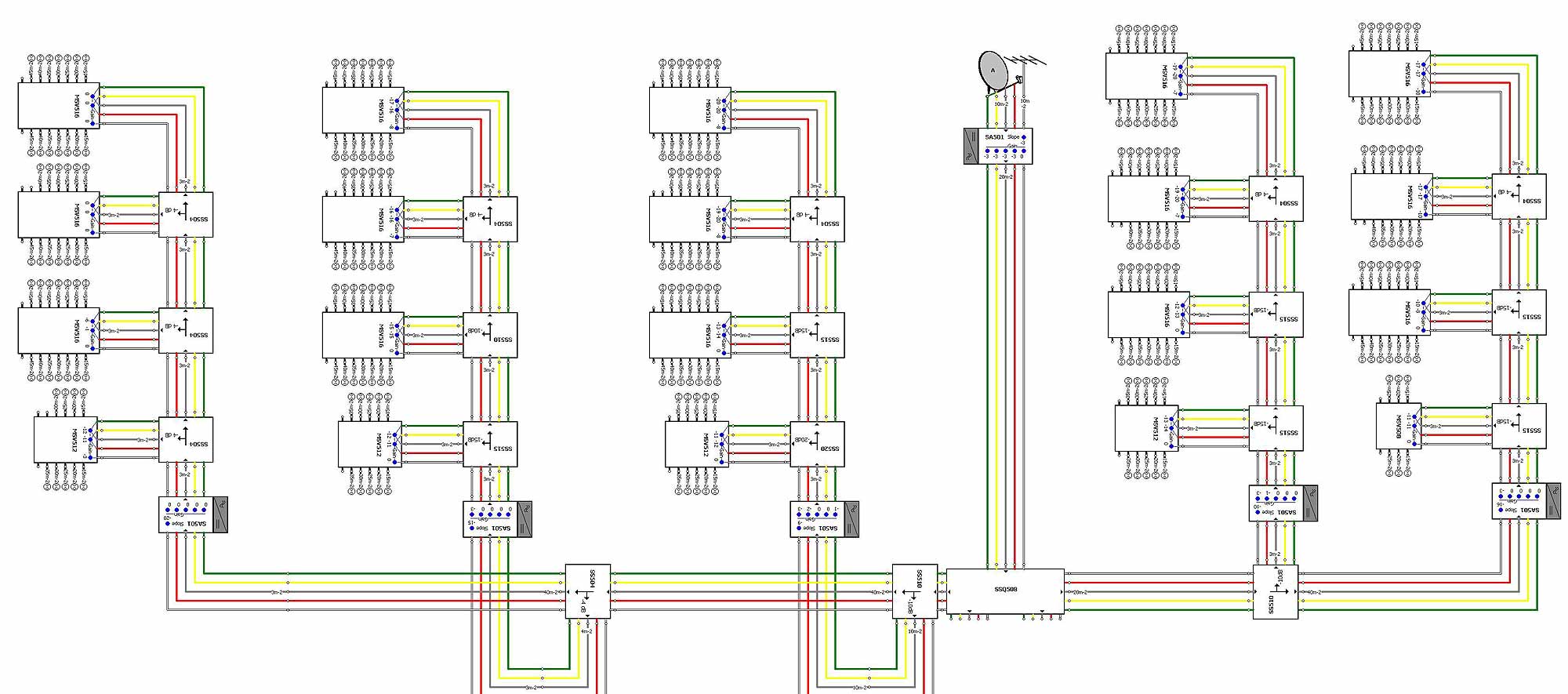
Multiswitch SMATV system in a 5-staircase building

The requirements for the building installations included SMATV system providing each outlet with DVB-T and SAT signals (from a single Hot Bird position).

The building has five staircases with a 40 m spacing. There is an underground garage in the basement below the ground level (first flloor). The basement should be used for the distribution of the signals to all the staircases (the investor did not want separate systems in individual staicases) via a bus composed of five Triset-11 PE E1025 cables.

UHF TV Antenna: DIPOL 94/21-69 Vena
View of the project of the SMATV system designed with the use of free SatNet utility
Instructional video on the use of the software
 
 
Due to a large number of the outlets in the building (ca. 300), the optimum choice was multiswitch system based on a bus architecture and MSV-5xx multiswitches.
 
In this implementation, three stories in each staircase have been equipped with MSV-516 R70716 multiswitch and satellite splitter or tap from Terra SS-5xx series with the loss resulting from the energetic balance. The exception is the last, fourth floor, equipped in each staircase only with the MSV-516 R70716 multiswitch. The total number of outlets in each staircase is about 60.

The system is powered from SA 501 R70501 amplifiers located in each staircase, via H lines.

12.10.2012

Time for a global M2M platform

At the end of November in Johannesburg, Vodacom from Vodafone Group Plc announced the start of a new M2M initiative called Global Data Service Platform (GDSP). The project is a part of the policy of the group being a global service provider for M2M solutions. GDSP is aimed at international companies and organizations wanting to use automatic and unassisted global communication among various devices.

GDSP is a service that not only allows the transfer of information and communication between devices scattered around the globe, but also enables the user to fully manage and control the whole system. This pioneering solution provides means for users to analyze in detail the flow of information between different points, as well as to control each individual point. The operation of such a network is not complicated - the management, control and analytical tools can be easily accessed by an intuitive graphical interface.

M2M (Machine-to-Machine) technology is based on the ability of devices connected to the network for collecting, processing and exchanging information without human intervention. The development of mobile technology in recent years has made this application area the leader in terms of annual turnover: $ 445 billion. Independent organizations estimate that by the end of 2020 the number of M2M devices in the world will increase by 100%, from 6 to 12 billion. 
 
Businesses interested in M2M technology are logistics companies (fleet and asset management), banks (remote monitoring of subsidiaries, ATMs etc.), healthcare providers (continuous remote monitoring of biological data) and many others. The list of organizations and companies operating in dispersed locations is huge, so Vodafone, anticipating a significant growth of interest in M2M applications, has prepared 5 billion SIM cards to enable wireless communication for compatible devices.


The global growth of M2M applications will translate into an even more dynamic expansion of wireless data services for private customers. Research confirms that many consumers that can use WiFi connectivity choose 3G service. This shows how managed cellular networks are important for secure and reliable communication and data exchange.

12.06.2012

How to maximize the capabilities of home routers?

Thanks to alternative software available on the Internet, many Wi-Fi routers can provide extended functionality. For example, the software may transform home router into NAS and print servers, increase forwarding performance, provide advanced analytical options.

Alternative software OpenWRT based on Linux (with optional graphical user interface) can be uploaded on selected models of wireless routers/APs. The software greatly extends the capabilities of the devices. It should be emphasized that all operations associated with the modification of the firmware are done at the user's risk. The best option is to install the software via a USB port of the router (if available, it can be also used to connect a hard drive, USB modem or printer; application of additional USB hub will enable simultaneous operation of several devices).
Wireless IP Camera: TP-LINK TL-SC3130G (0.5 lx, VGA, 30fps, MPEG-4, 4 mm)Wireless USB Adapter: TP-Link TL-WN721N (802.11n, 150Mb/s)Access Point TP-Link TL-WR1043ND (w. router & GbE switch, 802.11n, 300Mbps)
Home wireless network based on TP-LINK devices

OpenWRT software and additional information are available at that official site. In the case of other versions modified by some users, which can also be found on the Internet, one should pay particular attention to security issues. More on OpenWRT can be found in the article OpenWRT or how to maximize the capabilities of your router.

12.05.2012

Long-range HDMI splitter

HDMI Splitter-Extender Signal-HD 1x8 H3607 enables the user to connect up to 8 modern TV sets equipped with HDMI inputs to one source of high-definition signal. The amplified output HDMI signal can be transmitted via HDMI 1.3b cable over distance up to 15 m. The seven RJ45 outputs allow for signal transmission over distances up to 50 m (using a CAT6 cable). The package contains the set of RJ-45 to HDMI adapters and power supplies. The features of the product make it ideal for demonstration of HD televisions and other equipment in stores, for offer presentation in HD quality in superstores, for distribution of video content (such as transmissions of football matches) in clubs and pubs etc.


Signal-HD HDMI Switcher 2x1
HDMI Splitter-Extender Signal-HD 1x8 (7xRJ45, 1xHDMI) H3607


Application diagram

12.04.2012

Will SAT>IP be a quantum leap in satellite reception?

In early November, SES, the world's leading satellite operator, issued a certificate of compatibility for Zinwell SAT>IP switch/ server, stating compliance of the device with the approved in 2011 SAT> IP standard. The ZIM-1800 switch/server from the Taiwanese manufacturer has become the second SAT> IP device that gained the approval of the organization responsible for developing this standard (the SAT> IP Project partners include SES, BSkyB, and Craftwork). The first certified SAT>IP converter was IDL400S Multibox developed by Inverto Digital Labs. Thomas Wrede, Vice President of Reception Systems at SES, emphasizes the fact that other Asian manufacturers are also interested in the certification. It seems that the rise in popularity of the SAT> IP technology is only a matter of the near future.

According to the SAT> IP standard, satellite signals are demodulated and then converted into IP streams that can be distributed through wired or wireless IP networks. The user of the network can independently watch satellite channels on devices such as PCs, laptops, tablets, and smartphones running dedicated applications. Of course, the content will also be available on Smart TVs and other televisions equipped with external network adapters or IPTV receivers (IP STBs). The communication protocol between the server and clients has been developed by the consortium of satellite operator SES, UK broadcaster BSkyB, and Danish TV software company Craftwork. SAT> IP is based on existing Internet protocols such as IP, UPnP, RTSP, HTTP, supplemented by a special extension for satellite content. The solution is compliant with DLNA protocol implemented in many consumer devices.


SAT>IP servers can distribute satellite media streams in unicast or multicast RTP/UDP (RFC2250) mode,as well as they support HTTP streaming. The delivery format is chosen by the client device.
One of the major advantages of the SAT>IP solution is its total independence from the Internet. Despite the use of IP technology, the transmission takes place only in the local network, not generating any additional costs (no need for higher Internet bandwidth). A typical home network operating at 100 Mbps will allow for simultaneous transmission of 8 different HD channels.

If the forecasts of the creators of the SAT> IP standard are correct, the year 2013 can bring a great revolution in consumer satellite market. With a range of certified devices, their prices should fall to levels acceptable by the majority of individual users of FTA channels and the operators of pay-TV platforms, which will change the form of using home television systems. A greater integration of television and home IP networks will lead to a practical implementation of the idea of ​​watching TV "everywhere and on anything" (at least in the home).

11.30.2012

Sprayed-on or printed solar cells

Let's paint the roof with special paints and we'll have a home power plant... This vision is not so awkward after the announcement that scientists have built a solar cell based on Colloidal Quantum Dot (CQD) films with a record-breaking efficiency of 7%, about 40% higher than that of the best previous devices using CQDs.

Although commercial cells based on traditional silicon technology have efficiency of 15-20%, which is up to three times higher than in the case of the new achievement, the sharp increase in CQD cell efficiency promises a number of interesting applications. They will result from the way of the production of the new cells, with the use of special paints or even just by printing using inkjet printers.


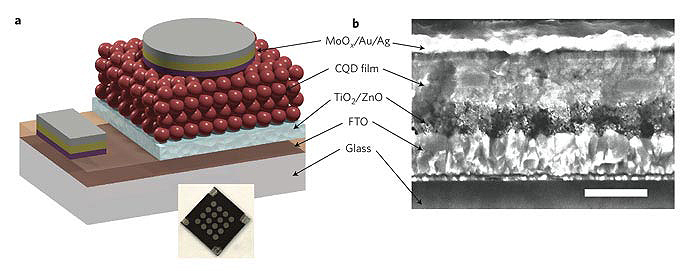
a) diagram of the solar cell made ​​out of colloidal quantum dot film
b) cross-section photographed by a scanning electron microscope

(source: physicsworld.com)
 
 
Colloidal Quantum Dot (CQD) films employ the recent developments in nanotechnology, particularly the phenomena taking place in so-called "Quantum dots" - ultra-thin semiconductor layer with unique light-capture properties. Quantum dots is an integrated thin film of thickness several to tens of nanometers, divided into cells ( "dots") of similar dimensions. It is worth to note that the wavelength of visible light ranges from 400 to 700 nm and 1 nanometer is one millionth of a millimeter.
 
 
The capturing of photons that increase the energy of electrons is the basis of all solar cells. The small surface and thickness of a "quantum dot" restricts the free movement of particles. By analogy to a shooting gallery, the photon has a greater chance to hit the immobilized electron instead of one constantly vibrating in a haphazard manner - hence the greater efficiency.
 
 
The problem is the selection of materials and mastering the technology, but the prospective performance levels are impressive, especially when combining existing and quantum technologies. In October, the United States Air Force commissioned Magnolia Solar to develop nanotechnology solutions for reaching the efficiency of solar cells intended for the defense and space industries close to 50%!


The total power used by humans is only about 0.02% of the solar radiation power reaching the Earth. The solar energy received by the Earth during six months equals the amount of energy contained in the estimated resources of the currently used fuels - coal, oil, gas and uranium. The total energy that reaches a horizontal surface throughout the year ranges from 600 kWh/m²/year in the Nordic  countries to more than 2500 kWh/m²/ year in central Africa. All the energy of solar radiation absorbed by the Earth, also used in any form by plants and animals, is transformed into heat and then emitted as infrared radiation into outer space. Development of a new generation of photovoltaic cells will allow for better absorption and use of solar energy.

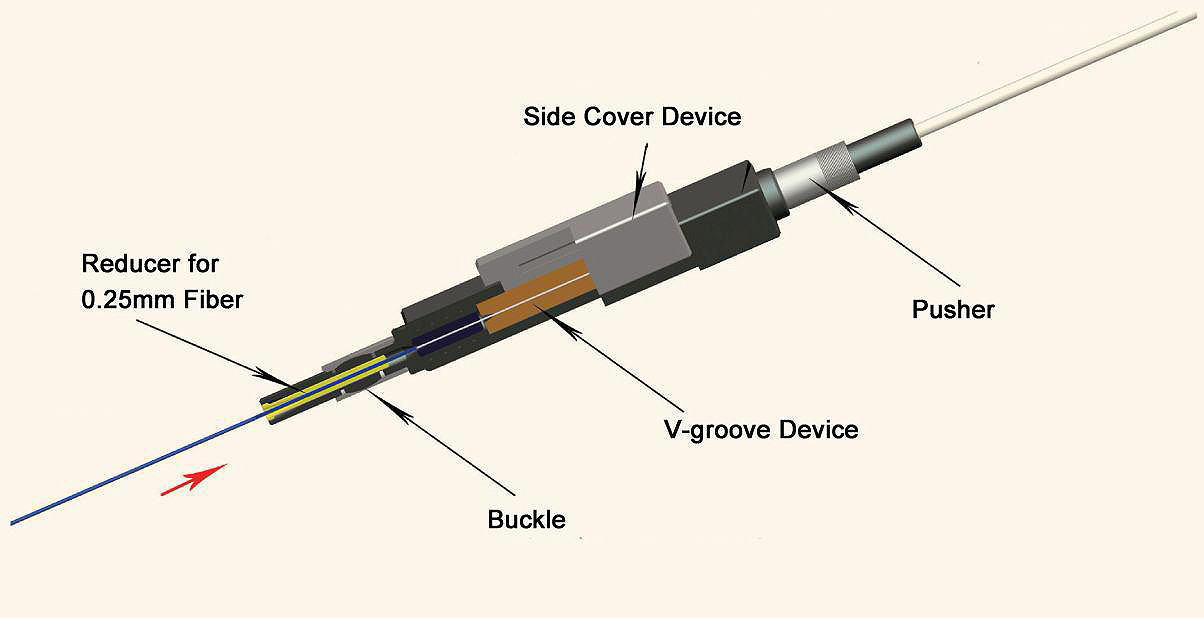
The construction of a mechanical splice

Mechanical splices ULTIMODE FAST-MS1 are used for permanent connections of optical fibers without the need of employing fusion splicers. Everything the installer has to do before application of the splice is to remove the protective layers (jacket and aramid fibers), strip the buffer, clean the core cladding and cleave the fiber with the two active layers.


The main components of Ultimode FAST-MS1 L5550 mechanical splice
 
 
The prepared ends of the fibers to be spliced should then be inserted to the both sides of the L5550 mechanical splice. The body of the splice contains V-groove device with holes slightly larger than the fibers. These holes are filled with optical gel compensating for cutting imperfections and imprecise positioning. After full insertion of the fibers, they have to be locked with the buckles. The versatile design of the mechanical splice allows for splicing optical fibers with buffer coating diameters of 0.25 mm (using the included reducer) and 0.9 mm.